


Engagement, Fun, and Learning: Mathematical Play for Early Numeracy
Robin Sharma
|
January 09, 2026

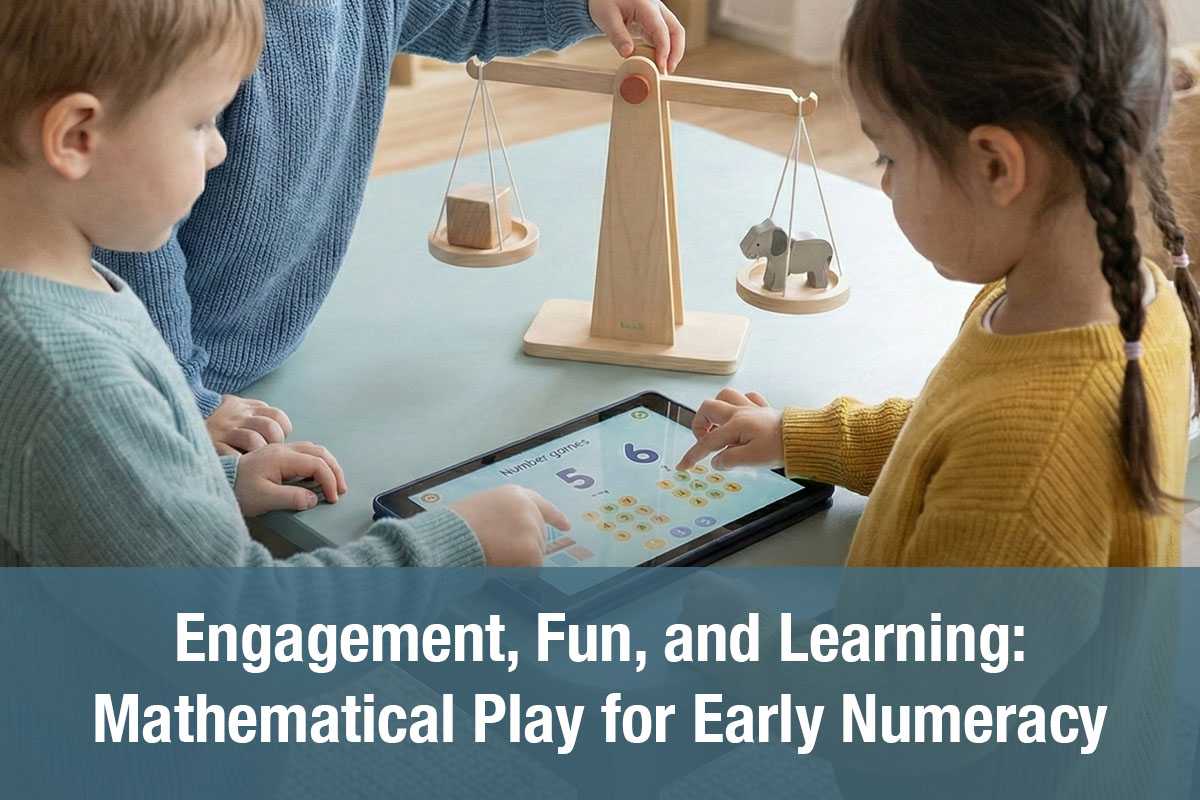
Digital games have the potential to be engaging learning tools as they can offer adaptive problem-solving in a low-stake environment[1]. Additionally, they can add value over textbooks and videos by offering interactive, multi-modal experiences tailored to the learners’ needs. However, “engagement” does not always translate to learning[2]. Research has shown that the “type” of engagement created by a learning environment determines its impact[3]. Engagement unrelated to the learning goal can often cause extraneous cognitive load, deviate the player away from the learning goal, and hinder knowledge acquisition[4]. Entertainment games usually have one primary goal of keeping the player motivated, engaged, and immersed in the gameplay. However, good learning games ensure that this gameplay is also meaningfully linked to the learning goals.
Specifically for math games, designing gameplay where engagement is meaningfully linked with the learning goal is critical to address disciplinary issues like math anxiety, negative math attitudes, and social stigma associated with math. Moreover, mathematicians work with a set of rules called “axioms” and “postulates”. Games can be effective for math learning as they can simulate the mathematical rules (axioms) as game rules. By simulating math rules as game rules, digital games can promote mathematical thinking in players. This linking of “play” and “math learning” is often called “mathematical play”[5]. Providing young children with opportunities of mathematical play can promote mathematical thinking and build foundational understanding of math concepts. However, due to the complex, abstract, hierarchical, and interrelated nature of math concepts, designing digital learning experiences that harness the potential of mathematical play is challenging. Math games are often poorly designed and found to be ineffective[6]. A review of “math” apps on the Apple App Store found that even the “top” apps lacked key benchmarks of educational quality and were poorly designed[7]. A main critique of some “bad” math games is the lack of connection between gameplay and learning[8]. They include “play”, but most often it is not linked with math learning outcomes and hence it’s not “mathematical play”. For example, a game might include players “shooting” an enemy and then solving a math problem to upgrade their “gun”. Here, the action of solving the math problem is not linked with gameplay (shooting) and is not categorized as mathematical play. A better way of implementing this approach could be to implicitly connect “shooting” (gameplay) and “problem solving”. This can be done by only allowing the player’s gun to shoot only when they correctly solve the math problem. Moreover, their speed of solving the problem can be linked with the type of gun upgrades.
Researchers have argued for developers to design play and interactions that are thoughtfully intertwined with mathematical learning. The “Learning Mechanic - Game Mechanic” (LM-GM) Framework[9], argues that each game-related element of a learning game (e.g., type of interaction, rewards, etc.) be mapped to the learning-related elements (e.g., learning to count, writing numbers, etc.). This means that all game features are associated with the intended learning outcomes. For example, the incentive system (rewards and penalties) can be designed in a way that encourages mathematical play over the “trial and error”, or the “game objects” can represent mathematical objects. A specific example of this type of implementation is the game “GeometryBOX”[10]. If players use a trial and error approach to solve geometrical problems, the incentive system penalizes them, they lose resources, and are unable to make progress. They need to strategize mathematically and apply their math knowledge to make progress. Additionally, the in-game objects like “jewels” are represented in the form of 2D shapes directly associated with geometry learning. Finally, the increasing level of difficulty in GeometryBOX is based on the geometry-specific learning theory, the Van Hiele Model (VHM)[11]. This type of design approach, based on relevant learning theory and mathematical play, showed significant improvements in geometry learning among adolescents.
Mathematical play for early numeracy
Similarly, when designing digital games for young children, it is important to consider the links between gameplay and learning. Early years numeracy is known to be critical and foundational for overall development and math achievement[12]. Hence, design decisions should be based on strong and relevant learning theories of early numeracy and mathematical cognition. Lets see some examples of game features and mechanics aligned with findings from learning sciences.
- Embodied cognition theory focuses on bodily interactions with the learning environment to build knowledge and understanding[13]. It argues that learning activities should promote the interaction of one’s body with physical-material. Motion-responsive technologies have the potential to elicit meaningful connections between bodily interactions and mathematical cognition in children. For example, games played on touch-responsive screens can build “drag and drop” mechanics to develop “one-to-one correspondence”, a key principle for counting. Children use their fingers to drag and drop objects and count as they make the action. Such bodily interactions, applying embodied cognition, have the potential to promote deep learning.
- Another key principle of counting is “stable-order” which refers to the child’s ability to memorize, speak, and understand the number words in correct order[14]. Voice-capturing technologies can be used to analyze children’s verbal counting. But simply asking children to say the number words and analyzing their response does not entail mathematical play. Instead, a game where children control a character’s movement by saying the number words in the correct order is better suited for engagement in mathematical play.
- Research has shown that offering diverse, multi-modal representations of mathematical concepts can benefit children’s development in early numeracy. In addition to visuals, digital games can present learning material, supports, and feedback via audio. They can apply auditory cognition theory which focuses on auditory cues and interactions within the learning environment to build understanding[15]. Emotional design principles identified by researchers on game-based learning also list “musical score” in games as a key feature for learning[16]. For example, games that aim to build counting and pattern recognition can engage children in gameplay that requires them to count chimes, replay chimes that they hear, and differentiate between different types of chimes.
As opposed to learning apps, learning games have the potential to make learning fun by engaging children in context-based problem solving. However, it is critical that engagement is driven by mathematical play, based on theories of learning, and not on distracting environments, characters, and other game objects.
Limitations and Considerations
It is critical that learning games do not fall victim to the “engagement fallacy” which assumes that engagement always leads to learning[17]. To avoid such pitfalls, the next generation of math games should design experiences that engage children in mathematical play over “bells and whistles”. It is also critical that developers are cognizant of the technological limitations. For example, AI-based voice analysis is limited by its ability to analyze children’s voices which are different from adults and differentiate among accents. Hence, learning technologies should be designed with caution and used to complement hands-on learning experiences. As argued earlier, digital games can support mathematical learning in a fun and meaningful way. However, it is important that they are based on relevant learning theories and promote “mathematical play”. Designing research-backed gameplay that utilizes the potential of new technologies in meaningful ways is crucial for their effectiveness.
About the Author
Robin Sharma is a creator of science-based, digital learning environments (DLEs). As Vretta’s Learning Scientist, he is working with the Innovation Team to create an AI-driven and research-based application for early numeracy. Robin has expertise in mathematics education, digital-game based learning, and curriculum development. He has a Ph.D. in Learning Science from McGill University, and an M.Sc. in Mathematics Education and a B.Sc. in Mathematics Honors from the University of Delhi.
Previously, he managed the “Games for Learning” program at UNESCO MGIEP. He led and co-authored the UNESCO guidelines on digital learning, a set of principles for ethical and responsible development of DLEs aligned with UNESCO’s framework on Education for Sustainable Development (ESD) and social-emotional learning (SEL). Robin has also worked in the videogame industry, developing the world’s first, interactive, gaming curriculum guides for teachers. These guides aim to support educators’ adoption of the immersive Assassin’s Creed Discovery Tour video games by Ubisoft.
Robin is an active member of the EdTech Impact Network managed by the International Center for EdTech Impact , Mathematics Teachers Association, and Game Research and Design Community (GRADE).
References
[1] Plass, J. L., O’Keefe, P. A., Homer, B. D., Case, J., Hayward, E. O., Stein, M., & Perlin, K. (2013). The Impact of Individual, Competitive, and Collaborative Mathematics Game Play on Learning, Performance, and Motivation. Journal of Educational Psychology, 105(4), 1050–1066. https://doi.org/10.1037/a0032688
[2] Papageorgiou, E., Wong, J., Liu, Q., Khalil, M., & Cabo, A. J. (2025). A Systematic Review on Student Engagement in Undergraduate Mathematics: Conceptualization, Measurement, and Learning Outcomes. Educational Psychology Review, 37(3), 66. https://doi.org/10.1007/s10648-025-10046-y
[3] Liu, Z., & Xiao, Y. (2026). Literature Review of Learning Engagement Research. In Z. Liu & Y. Xiao (Eds.), AI-Enabled Learning Engagement Analysis: Revolutionizing Education with AI (pp. 17–51). Springer Nature. https://doi.org/10.1007/978-981-96-6894-6_2
[4] Baah, C., Govender, I., & Subramaniam, P. R. (2024). Enhancing Learning Engagement: A Study on Gamification’s Influence on Motivation and Cognitive Load. Education Sciences, 14(10), 1115. https://doi.org/10.3390/educsci14101115
[5] Özdoğan, E. (2011). Play, mathematic and mathematical play in early childhood education. Procedia - Social and Behavioral Sciences, 15, 3118–3120. https://doi.org/10.1016/j.sbspro.2011.04.256
[6] Walter, D., & Schwätzer, U. (2025). Mathematics Apps Under the Magnifying Glass – An Analysis of the Inventory of Math Apps for Primary Schools Using German-Language Apps as A Case Study. Technology, Knowledge and Learning, 30(3), 1871–1893. https://doi.org/10.1007/s10758-024-09782-x
[7] Dubé, A. K., Kacmaz, G., Wen, R., Alam, S. S., & Xu, C. (2020). Identifying quality educational apps: Lessons from ‘top’ mathematics apps in the Apple App store. Education and Information Technologies, 25(6), 5389–5404. https://doi.org/10.1007/s10639-020-10234-z
[8] Kacmaz, G., & Dubé, A. K. (2022). Examining pedagogical approaches and types of mathematics knowledge in educational games: A meta-analysis and critical review. Educational Research Review, 35, 100428. https://doi.org/10.1016/j.edurev.2021.100428
[9] Arnab, S., Lim, T., Carvalho, M. B., Bellotti, F., Freitas, S. de, Louchart, S., Suttie, N., Berta, R., & Gloria, A. D. (2015). Mapping learning and game mechanics for serious games analysis. British Journal of Educational Technology, 46(2), 391–411. https://doi.org/10.1111/bjet.12113
[10] Sharma, R., Sharma, J., & Dubé, A. (2025). Effects of theory-based, narrative games on geometry learning among adolescents. American Educational Research Association Annual Meeting, Denver, USA. https://doi.org/10.3102/2185335 https://doi.org/10.3102/IP.25.2185335
[11] Hiele, P. M. van. (1999). Developing Geometric Thinking through Activities That Begin with Play. https://doi.org/10.5951/TCM.5.6.0310
[12] Raghubar, K. P., & Barnes, M. A. (2017). Early numeracy skills in preschool-aged children: A review of neurocognitive findings and implications for assessment and intervention. The Clinical Neuropsychologist, 31(2), 329–351. https://doi.org/10.1080/13854046.2016.1259387
[13] Abrahamson, D., Worsley, M., Pardos, Z. A., & Ou, L. (2022). Learning analytics of embodied design: Enhancing synergy. International Journal of Child-Computer Interaction, 32, 100409. https://doi.org/10.1016/j.ijcci.2021.100409
[14] Sarama, J., & Clements, D. H. (2009). Early Childhood Mathematics Education Research: Learning Trajectories for Young Children. Routledge. https://doi.org/10.4324/9780203883785
[15] Danielsson, H., Humes, L. E., & Rönnberg, J. (2019). Different Associations between Auditory Function and Cognition Depending on Type of Auditory Function and Type of Cognition. Ear and Hearing, 40(5), 1210–1219. https://doi.org/10.1097/AUD.0000000000000700
[16] Loderer, K., Pekrun, R., & Plass, J. L. (2020). Emotional foundations of game-based learning. In Handbook of game-based learning (pp. 111–151). The MIT Press.
[17] O’Brien, H. L., Roll, I., Kampen, A., & Davoudi, N. (2022). Rethinking (Dis)engagement in human-computer interaction. Computers in Human Behavior, 128, 107109. https://doi.org/10.1016/j.chb.2021.107109


About
MathemaTIC is a personalized learning platform that is designed to make the experience of learning mathematics engaging and enjoyable for every learner.


© Vretta Inc. 2026